Learn More

The mission of this new American Indian Center is to bridge the richness of North Carolina's American Indian cultures with the strengths of Carolina’s research, education and teaching. This will establish the University of North Carolina at Chapel Hill as a leading public university for American Indian scholarship and scholars and make native issues a permanent part of the intellectual life of the university.

Latest News

North Carolina Cultural Tourism Workshop

June 18-19, 2009 - 9:00 a.m.

Location: The William and Ida B. Friday Center for Continuing Education - UNC Chapel Hill

Sponsored by: - UNC American Indian Center

Time: Thursdsay, June 18 (9:00 a.m. - 6:00 p.m.) & Friday, June 19 (9:00 a.m. - 12 noon)

As a follow up to discussions at the N.C. Indian Unity Conference that was held in March 2009 and as a continuation of our Tribal Leadership Workshop Program, the American Indian Center has made contact with key individuals in planning for the Cultural Tourism Workshop for Tribal and Indian Urban Organization Leaders.

Tentative Agenda

REGISTRATION IS NOW CLOSED!

For additional questions regarding Hotel Accomodations and Travel Arrangements please email Randi Byrd at rrbyrd@email.unc.edu


Welcome Extravaganza for Carolina American Indian Community & Friends

Thurs., August 27, 2009 - 5:00pm

Location: Side Lawn of Abernethy Hall (Corner of S. Columbia & Cameron Ave.)

Time: 5:00pm - 7:30pm

Music and information about American Indian student organizations at the University of North Carolina at Chapel Hill will be part of a welcome event on campus beginning at 5:30 p.m. Aug. 27.

The UNC American Indian Center will host the event, a Welcome Extravaganza for the Carolina American Indian Community and Friends, on the lawn of Abernethy Hall at South Columbia Street and Cameron Avenue. The public, including Indians from the surrounding area, are invited.

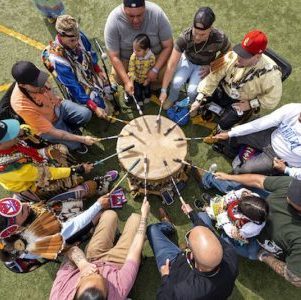
Renew acquaintances and make new friends at the American Indian Center. The event will feature intertribal dancing with dancers dressed in full regalia and native dress. The event is part of a Week of Welcome at Carolina to start fall semester.


Summer Session to study Cheroke Nation

Tues., May 27, 2009

UNC News Services - The Herald-Sun

Twelve students at UNC will experience a different kind of study abroad this summer as they live and learn in the Cherokee Nation.

The new American studies course, "Tribal Studies: The Cherokee Nation," was developed by UNC faculty members Theda Perdue and Tol Foster in the College of Arts and Sciences. It represents a partnership between Carolina and Northeastern State University in Tahlequah, Okla. Northeastern State has the highest enrollment of American Indian undergraduates in the world -- and some of those students will join their UNC peers and share their understandings of the contemporary Cherokee Nation.

UNC students will live in Tahlequah from May 24-June 14. The course will combine formal classroom time with field trips, and students will be required to blog about their experiences. Students will take introductory Cherokee language; study contemporary Cherokee film, animation, art and literature; and take the law and history course designed for employees of the Cherokee Nation by tribal council member Julia Coates. Coates is assistant professor of American studies at the University of California, Davis.

Students also will participate in cultural activities including Cherokee marbles, stickball and the stomp dance. They will go to Cherokee Nation tribal headquarters and meet with Principal Chief Chad Smith. They also will visit Sequoyah High School; Fort Gibson, where the Trail of Tears ended for many Cherokees; the house of Sequoyah, credited with developing a written form of the Cherokee language; and the historic Cherokee Female Seminary, among other sites.

In 1838 and 1839, as part of President Andrew Jackson's Indian Removal policy, the Cherokee Nation was forced to abandon its lands east of the Mississippi River and migrate to Oklahoma. During this forced march, now known as the Trail of Tears, more than 4,000 of the 15,000 Cherokees died of hunger, disease or exhaustion.

Phyllis Fife, a citizen of the Mvskoke Creek Nation and director of the Center for Tribal Studies at Northeastern State, will coordinate language instruction for the UNC students, along with other cultural experiences.

"This unique program will allow students to be fully immersed in the contemporary cultural life of one of the most dynamic and successful tribal nations in the world," said Perdue, the Atlanta Distinguished Professor of history at UNC. Perdue has been writing and teaching Cherokee history for 35 years.

Foster, a citizen of the Mvskoke Creek Nation and assistant professor of American studies, will be the residential UNC faculty member in Oklahoma and teach the course component on literature and film. He specializes in American Indian literature as well as Oklahoma tribal regional studies, and he grew up in eastern Oklahoma.

"We are excited about the chance for this summer class to follow the Cherokee exodus 1,000 miles west to the national Cherokee capitol," Foster said. "Students will have unparalleled access to the people who make up a contemporary sovereign tribal nation -- Indian health experts, tribal policemen, Cherokee animators, environmental officers, scholars and cultural leaders."

The course is subsidized by the Burch Field Research Seminar Program at UNC.


UNC junior awarded Morris K. Udall Scholarship

Marion Boulicault of London, a junior at the University of North Carolina at Chapel Hill, was studying abroad in the Mekong Delta of Vietnam when she heard the news. She had been chosen by the Morris K. Udall Scholarship and Excellence in National Environmental Policy Foundation in Tucson, Ariz., as one of 80 Udall Scholars for 2009. The recipients were chosen recently from among 515 candidates nominated by 233 colleges and universities nationwide.

Marion Boulicault of London, a junior at the University of North Carolina at Chapel Hill, was studying abroad in the Mekong Delta of Vietnam when she heard the news.

She had been chosen by the Morris K. Udall Scholarship and Excellence in National Environmental Policy Foundation in Tucson, Ariz., as one of 80 Udall Scholars for 2009. The recipients were chosen recently from among 515 candidates nominated by 233 colleges and universities nationwide.

Congress authorized the Udall Foundation in 1992 to honor the late Congressman from Arizona. A trust fund in the U.S. Treasury and private contributions support the foundation. Udall, who served in the House of Representatives from 1961-1991, advocated environmental conservation and championed the rights of American Indians and Alaska natives.

View Full Article

Voices Newsletter

End sidebar content

WUNC LogoListen to AIC's Clara Sue Kidwell, on WUNC's “The State of Things”


FIND US ON FACEBOOK!

This university-wide Center will advance the University’s mission
of research, teaching, and service through the following goals:

Leadership in American Indian Scholarship and Research
By creating an environment in which quality research and scholarship related to American Indians is stregthened and nutured, the University can become the premier university in the East for American Indian research and knowledge dissmentation.
Engagement with and Service to North Carolina’s First People
By serving as the University’s front door to American Indian communities, this Center will enable Carolina, as the University of the People, to truly serve the First People of North Carolina as well as the First people of the South and the East.
Enrichment of Campus Diversity and Dialogue
By facilitating the inclusion of the American Indian peoples, with their unique and rich cultures, traditions, beliefs, and histories, the learning environment of the entire Carolina community will be enriched.

Announcements

The "Gift of the Old Well" Painting

by Christoper H. Kennedy

This painting was created for the American Indian Center at UNC Chapel Hill and unveiled on March 20, 2009 at the American Indian Reunion Banquet.

The creator gave land to the people.  The people created a university.  The university builds an “Old Well” in 1795.  The “Old Well” gave life and sustenance to the people and animals.  The creator is pleased, the bear is the symbol of strength for the people, the cougar is the symbol of balance and grace, and the eagle is the symbol of leadership.  The pale of knowledge spills into the pool of the dream catcher and through time, hard work, and perseverance the “Old Well” is transformed into the current structure and the circle of life continues.

Prints of the painting are available for purchase, please contact Brandi Brooks at 919-843-4189.


Getting Started


ITS Web Services